
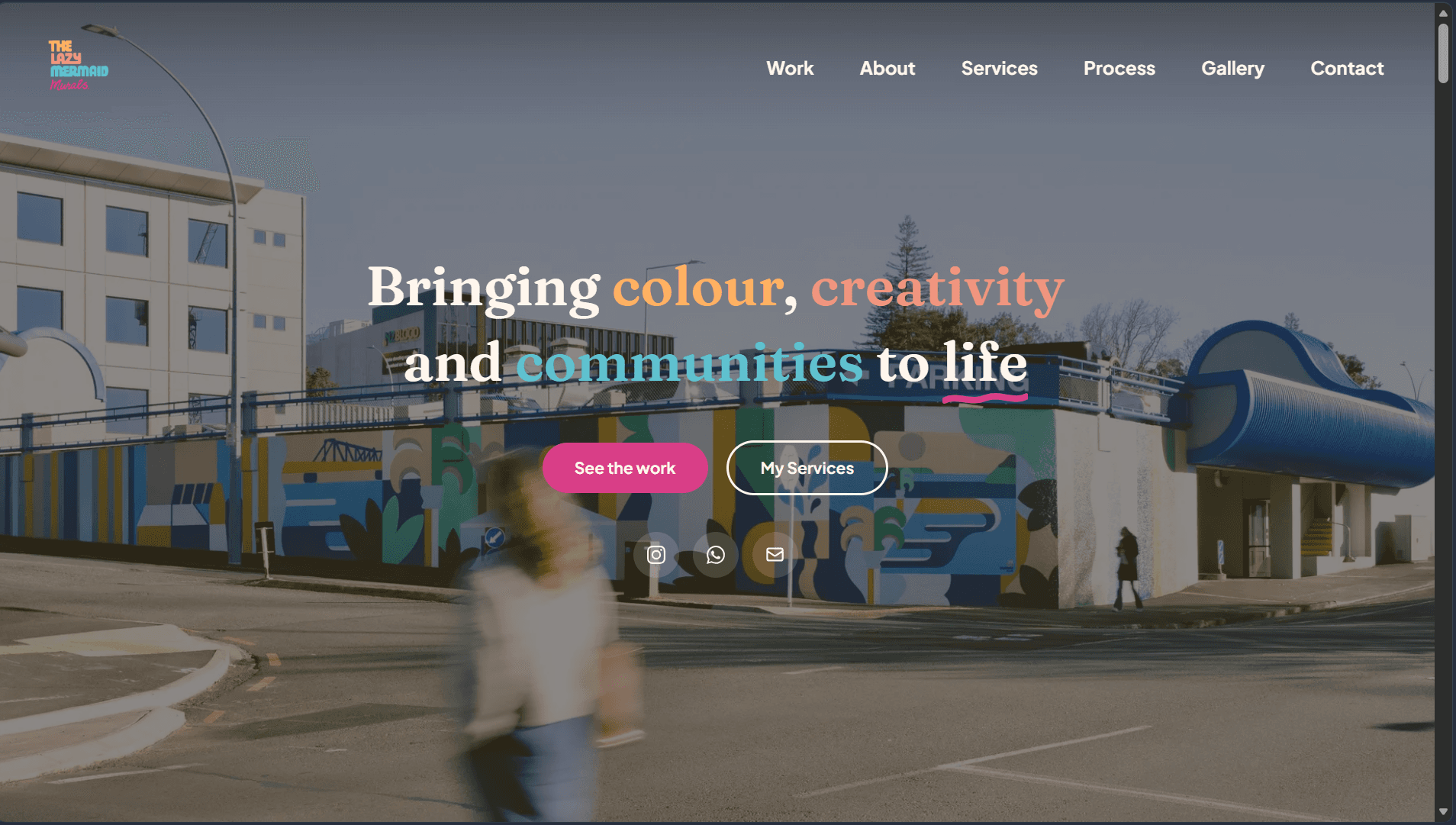
Most of my recent projects have been booking platforms -trekking companies, expeditions, catalogs with pricing logic and availability calendars. The Lazy Mermaid Murals was a genuinely different kind of brief, and it forced me to think differently about what a website is actually for.
Sarah Cornish paints murals - large-scale council commissions, commercial branding on walls, interactive floor art, school projects - out of Tauranga, New Zealand. Her work is the entire product. The website's only real job is to get out of the way and let the murals do the convincing.
The gallery had to come first, not last
On a booking platform, the database schema usually comes first - availability logic, pricing structure, the stuff that has to be right before anything else works. For a mural artist's site, none of that matters if the gallery experience is weak.
I built this one on Sanity as a headless CMS specifically so Sarah could manage her own portfolio going forward - add a new mural, drop in photos, and have it show up on the site without ever touching code. Every project got its own detail page (full-height carpark facades, interactive floor murals, sensory-friendly community pieces), each with proper dimensions, the client's name, and a description that reads like her, not like generic marketing copy.
The featured-work section on the homepage pulls six pieces with real specificity - a 160 sqm carpark mural for Tauranga City Council, a 'Shell Hop' interactive floor mural, a therapy room mural painted alongside local youth. Specificity is the entire trust signal here. A generic "check out my amazing murals!" section convinces nobody. Real numbers, real client names, and real project scope do.
Services needed to route straight into the contact form
Sarah's work spans genuinely distinct categories - public art for councils, commercial branding, school artwork, interactive floor pieces, full branded spaces. Someone landing on the site already usually knows which one they want, so I built the services section to pre-fill the contact form based on which service card they clicked, the same query-param pattern I use on my own Services page. Click "Commercial murals," land on a contact form that already knows that's what you're asking about.
Small detail, but it removes one full step of friction between someone getting excited about a mural idea and actually reaching out.
The FAQ had to answer the one question everyone actually has
Mural pricing is genuinely opaque to most people - there's no obvious reference point the way there is for, say, a haircut or a coffee. So, the FAQ leads directly with it: a clear per-square-meter rate, with a realistic range for a typical residential piece, before any of the softer questions about surfaces or timelines. Burying the pricing question five FAQs down would have meant most visitors never got the one answer they actually came looking for.
Built in a week, and what that actually meant
Seven days for a site like this only works because the scope was genuinely well-defined from the start - Sarah knew her services, had strong existing photography of her work, and didn't need a custom booking engine or payment logic sitting underneath it. The complexity here wasn't backend logic, it was making sure the presentation layer - the gallery, the process walkthrough, the testimonials - actually did justice to work that's inherently visual.
That's the real lesson from this one: not every project needs the same kind of engineering effort to be worth building carefully. Sometimes the hardest part isn't the code, it's making sure a wall someone painted with their own hands reads as well on a screen as it does in person.
You can see the live site at thelazymermaidmurals.com.